

01 / Foundation
OCA examines how structure, relationship, rhythm, interpretation, function, power and responsibility create organisational reality.
It gives leaders a disciplined way to read fragmentation, understand the conditions they continue to author and design for wholeness across people, organisations and the societies they shape.
Leadership is a design discipline. Wholeness is the central organising premise and the measure of its design.
02 / Architecture
Organisations live inside what they build
Organisational life is produced through design. Authority flows, meeting structures, decision pathways, role interfaces, performance standards, escalation routes, operational rhythms and the treatment of knowledge all establish what becomes possible, visible, credible or expendable.
Some of the most consequential design has ceased to appear as design. Accumulated decisions settle into ordinary reality. Patterns of authority appear natural, standards appear objective and repetition acquires the authority of truth. OCA brings those conditions back into view as matters of leadership responsibility.
Organisational design establishes organisational reality.
03 / Fragmentation
When coherence is dispersed while control remains
Fragmentation separates people from one another, from their own understanding, from collective potential and from a shared account of their context. Within organisations, it takes form through roles unable to see or coordinate the whole, functions whose alignment depends on permission, knowledge separated from those who generate it and standards that require continuing negotiation over whose experience counts.
It appears in recurring conflict, dispersed effort, local optimisation, unresolved decisions, displaced responsibility and success achieved by transferring cost elsewhere. Its effects can gather around individuals even when the condition is architectural.
Fragmentation is the architecture through which systems disperse coherence while maintaining control.
04 / Wholeness
The governing premise and measure
Wholeness is the sustained integrity of the relationships among people, purpose, power, function, consequence and future capacity.
A whole organisation can contain tension, difference, conflict, unevenness and unresolved contradiction. Its wholeness lies in its capacity to remain in responsible relationship with those realities, make their structural meaning legible and prevent coherence from being maintained through silence, assimilation, depletion or transferred harm.
Individual wholeness
People retain dignity, agency, complexity, cultural integrity, discernment and meaningful relationship with their own labour. Participation does not require a person to divide the self or absorb systemic contradiction as the price of belonging.
Organisational wholeness
Purpose, power, responsibility, relationships, rhythm, function, ethos and future capacity remain in consequential relationship. Structural contradiction remains available for interpretation and response.
Societal wholeness
The organisation understands itself as part of a wider social ecology and accounts for consequences beyond its formal boundary, including what is transferred into communities, environments and future generations.
No level of the system can claim wholeness through the fragmentation of another.
05 / How leadership reads and acts
Perception, judgement and design in consequential relationship
Interpretive Literacy
Interpretive Literacy is the discipline through which leaders read patterns, power, history, burden and consequence without treating the dominant vantage point as the whole. It makes fragmentation, structural contradiction and transferred cost available for judgement.
Architecture
Architecture is how leadership acts upon what it has interpreted. It takes form through structures, relationships, rhythms, decision pathways, roles, information and the movement of power and responsibility.
Interpretation without architecture can produce insight the organisation cannot translate into action. Architecture without interpretive discipline can make harmful conditions more efficient.
06 / The watershed
How organisational conditions shape flow
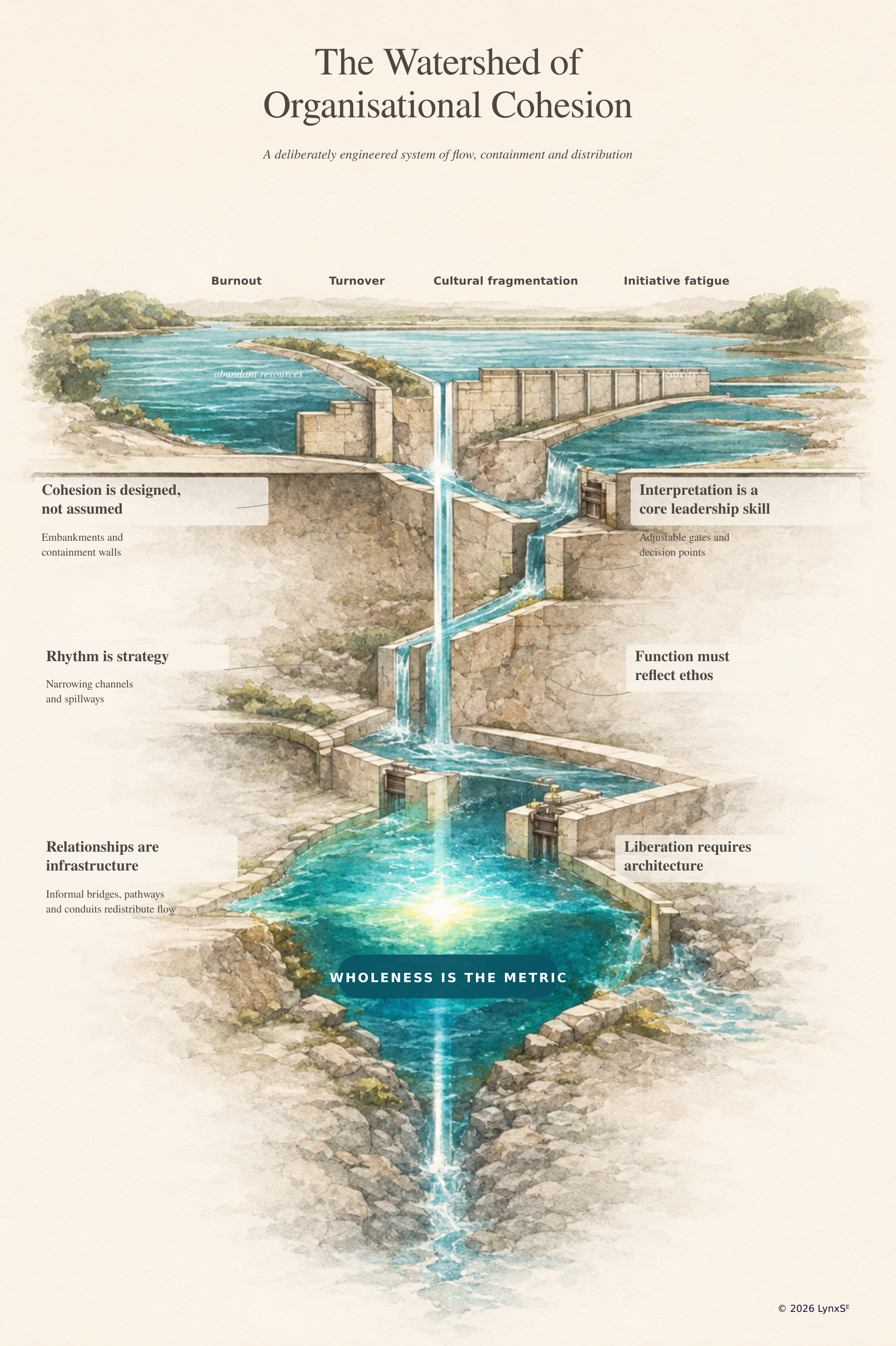
OCA uses the watershed to make architecture visible: where resources gather, how responsibility and information move, which gates regulate access and where fragmentation, depletion or wholeness accumulate.
 View full-size figure
07 / The seven principles
Disciplines of organisational and leadership practice
The seven principles translate OCA's governing premise into practice. Wholeness remains named among the seven while also giving the full architecture coherence.
- 01
Cohesion Is Designed, Not Assumed
Leadership carries responsibility for the conditions through which collective purpose, judgement and action can hold together under pressure.
- 02
Wholeness Is the Metric
Organisational design is assessed through the integrity of relationships among people, purpose, power, function, consequence and future capacity.
- 03
Relationships Are Infrastructure
Relationship is a principal medium through which the whole is held, repaired and made capable of action.
- 04
Rhythm Is Strategy
Temporal design protects or depletes capacity and determines whether coherence can be sustained across cycles, transitions and pressure points.
- 05
Interpretation Is a Core Leadership Skill
Leadership must perceive how meaning is made and where fragmentation, burden and consequence are produced, concealed or transferred.
- 06
Function Must Reflect Ethos
Purpose, values and operation remain in integrity through systems, protocols, resource decisions and response patterns.
- 07
Liberation Requires Architecture
Durable wholeness requires arrangements capable of interrupting domination, extraction and the fragmentation of others.
Developmental note. The theoretical relationship between Wholeness Is the Metric and the other six principles remains under active development. Public versioning preserves that movement.
08 / Intellectual origin and lineage
The Thesis of Us
The Thesis of Us is the originating inquiry into fragmentation, self-determination and the recovery or creation of wholeness at the level of the person. Its movements examine how identity, agency and possibility are shaped within systems that divide, name and constrain.
OCA extends that inquiry into collective life. It asks what happens when people formed within fragmenting systems enter organisations that are themselves fragmented, and what architecture allows people to participate in collective purpose while retaining dignity, agency, complexity and cultural integrity.
09 / Intellectual and lived location
Jamaican, Caribbean and Black diasporic
OCA is developed from Dr Alison Allen-Hall's Jamaican, Caribbean and Black diasporic intellectual and lived location while addressing conditions that travel across organisations and societies.
This location shapes what OCA assumes about personhood, relation, history, power and institutional inheritance. The person is understood in relation. History remains active in present structures. Informal relation and improvisation are recognised as intelligence and examined for the architectural failures or unequal burdens they may be compensating for.
Caribbeanness shapes the theory's ontology. The breadth of Caribbean intellectual traditions remains larger than any single theory, and OCA's lineage will be articulated with increasing rigour as the canon develops.
10 / Authorship and status
A developing body of thought
Organisational Cohesion Architecture is an original and developing body of organisational and leadership thought and practice created by Dr Alison Allen-Hall. This public foundation records the current governing account. Individual concepts and principles may have their own version dates as the theory develops.
Recommended citation
Allen-Hall, A. (2026). Organisational Cohesion Architecture: Public Foundation. LynxSᴱ.
Public foundation · Version 0.1 · August 2026